
IR Sensor

Written by
Atribot team
Last updated
June 10, 2026
Introduction
Imagine a robot that can detect obstacles without touching them or an automatic door that knows when someone is nearby. These smart interactions are possible because of sensors that can "see" objects without physical contact. One of the most common sensors used for this purpose is the IR (Infrared) Sensor.
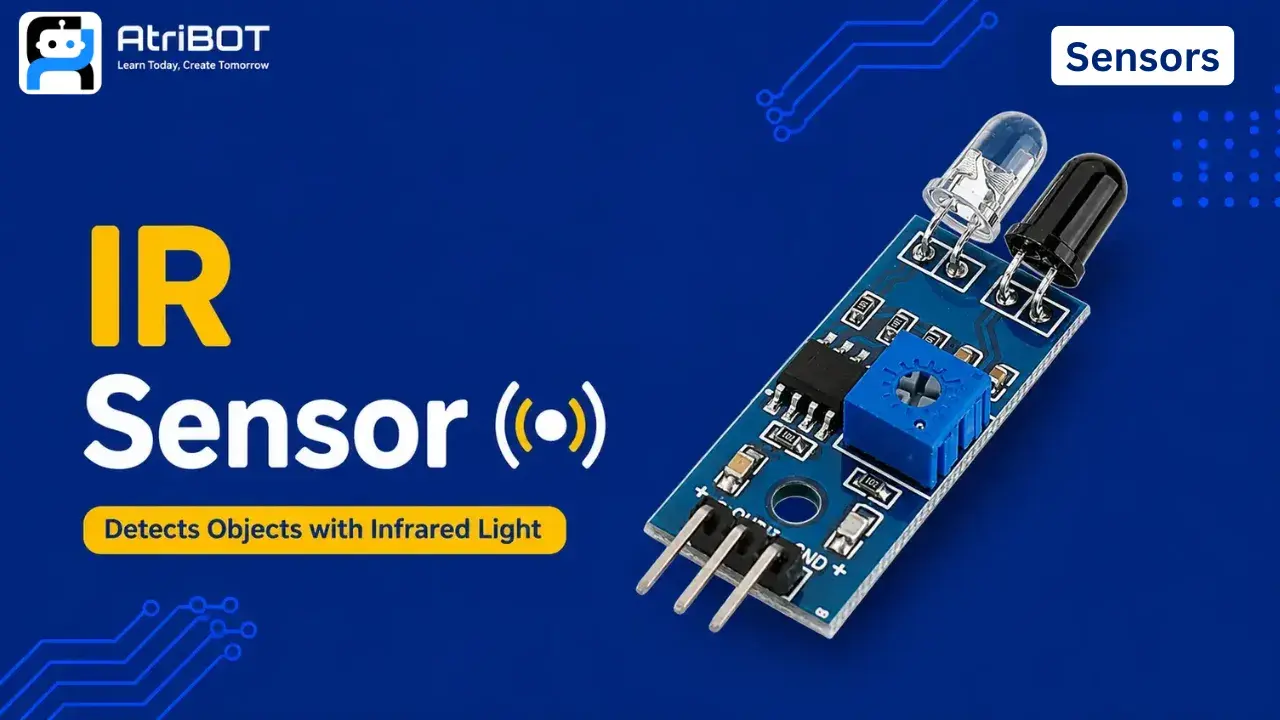
An IR sensor uses infrared light to detect the presence of nearby objects. It continuously emits infrared rays and monitors the reflected light to determine whether an object is within its detection range. Because of its simple design, fast response, and low cost, the IR sensor has become a popular choice in robotics, automation, and embedded systems.
From obstacle-avoiding robots and line-following robots to security systems and industrial automation, IR sensors are used in countless applications where reliable object detection is required.
In this article, you will learn about the IR sensor's main parts, pin configuration, technical specifications, working principle, advantages, disadvantages, and real-world applications.
Main Parts
1. IR LED (Transmitter)
The IR LED emits infrared light that is invisible to the human eye.
Functions:
Generates infrared rays
Transmits signals toward nearby objects
Acts as the transmitting component
2. Photodiode (Receiver)
The photodiode receives the reflected infrared light.
Functions:
Detects reflected infrared rays
Converts light into electrical signals
Helps identify nearby objects
3. LM393 Comparator IC
The LM393 comparator processes signals received from the photodiode.
Functions:
Compares received signals with a reference voltage
Generates digital output
Improves detection accuracy
4. Sensitivity Adjustment Potentiometer
The potentiometer allows users to adjust the sensor's detection range.
Functions:
Controls sensitivity
Adjusts detection distance
Enables calibration for different applications
5. Indicator LEDs
The module includes status LEDs for monitoring operation.
Functions:
Indicates power status
Shows object detection status
Simplifies testing and debugging
Pinouts
The IR sensor module typically contains three pins.
Pin | Description |
|---|---|
VCC | Power Supply (3.3V–5V) |
GND | Ground Connection |
OUT | Digital Output Signal |
Pin Functions
VCC
Provides power to the sensor module.
GND
Acts as the common ground connection.
OUT
Outputs a digital HIGH or LOW signal based on object detection.
Specifications
Parameter | Specification |
|---|---|
Operating Voltage | 3.3V – 5V DC |
Operating Current | 15mA – 20mA |
Detection Method | Infrared Reflection |
Detection Range | 2cm – 30cm |
Output Type | Digital |
Comparator IC | LM393 |
Detection Angle | Approximately 35° |
Response Time | Fast |
Indicator LEDs | Power and Detection LEDs |
Sensitivity Adjustment | Onboard Potentiometer |
Working Principle
The IR sensor works on the principle of infrared light reflection.
Step 1: Infrared Light Transmission
The IR LED continuously emits infrared rays toward the surrounding area.
Step 2: Object Reflection
When an object enters the detection range, the infrared light strikes the object's surface and reflects back.
Step 3: Signal Reception
The photodiode receives the reflected infrared rays and converts them into electrical signals.
Step 4: Signal Comparison
The LM393 comparator analyzes the received signal strength.
Step 5: Output Generation
If sufficient reflected light is detected, the sensor changes the state of the output pin, indicating the presence of an object.
Advantages & Disadvantages
IR sensors are popular because they are simple, affordable, and effective for short-range object detection. However, they also have some limitations.
Advantages
Low cost
Easy to use
Fast response time
Low power consumption
Compact size
Adjustable detection range
Simple interfacing with microcontrollers
Reliable for short-distance detection
Disadvantages
Limited detection range
Affected by sunlight and ambient light
Less effective on dark surfaces
Not suitable for precise distance measurement
Performance depends on object reflectivity
Applications
IR sensors are widely used in robotics, automation, and consumer electronics.
1. Obstacle Avoidance Robots
Detect obstacles and help robots navigate safely.
2. Line Following Robots
Detect black and white lines for path tracking.
3. Automatic Doors
Sense approaching people and trigger door operation.
4. Security Systems
Detect object movement and intrusions.
5. Object Detection Systems
Identify the presence of products in industrial automation.
6. Smart Home Devices
Enable touchless and automated interactions.
7. Parking Assistance Systems
Detect nearby obstacles around vehicles.
8. Industrial Automation
Monitor object positioning and production processes.
9. Counting Systems
Count products moving through conveyor systems.
10. Educational Electronics Projects
Used extensively in robotics and Arduino learning projects.
The IR Sensor is one of the most widely used object detection sensors in electronics because it offers a simple, reliable, and cost-effective solution for detecting nearby objects without physical contact.