
DHT11 Sensor

Written by
Atribot team
Last updated
June 10, 2026
Introduction
Have you ever wondered how weather stations measure temperature and humidity or how smart home systems monitor environmental conditions? To collect this information, electronic systems rely on specialized sensors that can accurately detect changes in the surrounding environment.
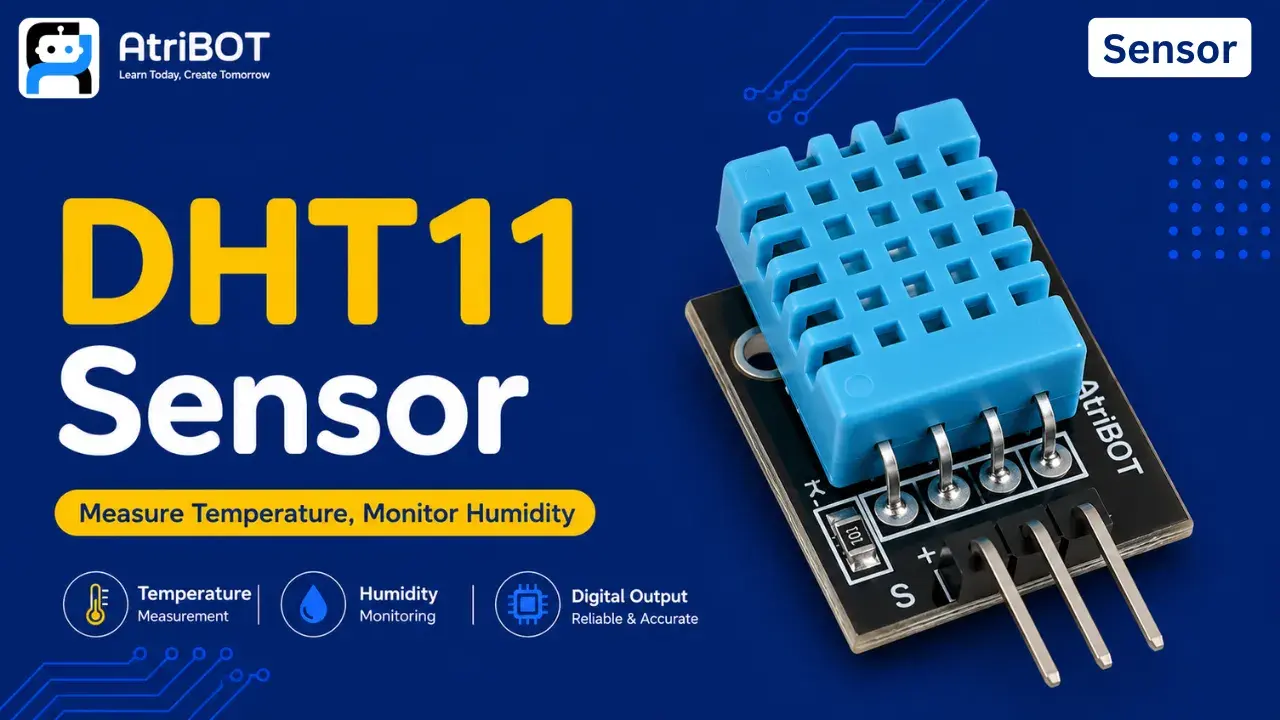
The DHT11 Sensor is one of the most widely used temperature and humidity sensors in electronics and Arduino projects. It combines a humidity sensing element and a temperature sensing component with a built-in signal processing circuit, allowing it to provide calibrated digital output data.
Due to its low cost, easy interfacing, and reliable performance, the DHT11 is commonly used in weather monitoring systems, smart homes, greenhouse automation, and educational electronics projects.
In this article, you will learn about the DHT11 sensor's main parts, pin configuration, technical specifications, working principle, advantages, disadvantages, and real-world applications.
Main Parts
The DHT11 Sensor consists of several internal components that work together to measure temperature and humidity and provide digital output data.
Humidity Sensing Element: The humidity sensing element is responsible for detecting moisture levels in the surrounding air. It measures changes in humidity and converts them into electrical signals that can be processed by the sensor.
NTC Thermistor: The DHT11 uses an NTC (Negative Temperature Coefficient) thermistor to measure temperature. As the temperature changes, the resistance of the thermistor changes accordingly, allowing accurate temperature measurement.
Integrated Circuit (IC): The built-in IC processes signals received from the humidity sensor and thermistor. It converts the measured values into calibrated digital data that can be transmitted to a microcontroller.
Protective Housing: The blue plastic enclosure protects the internal sensing components while allowing air to flow through the openings for accurate environmental measurements.
Connection Pins: The sensor includes pins for power supply, data communication, and ground connection. These pins allow easy interfacing with microcontrollers such as Arduino and ESP32.
Pinouts
The DHT11 sensor module typically contains three pins.
Pin | Description |
|---|---|
VCC | Power Supply |
GND | Ground |
DATA (S) | Digital Data Output |
VCC: Provides power to the sensor module. The DHT11 typically operates between 3.3V and 5V.
GND: Acts as the common ground connection for the sensor.
DATA: Transmits digital temperature and humidity data to the connected microcontroller.
Specifications
Parameter | Specification |
|---|---|
Operating Voltage | 3.3V – 5V DC |
Operating Current | 0.3mA – 2.5mA |
Humidity Range | 20% – 90% RH |
Humidity Accuracy | ±5% RH |
Temperature Range | 0°C – 50°C |
Temperature Accuracy | ±2°C |
Output Type | Digital Signal |
Sampling Rate | 1 Hz (One Reading Per Second) |
Communication Protocol | Single-Wire Digital Interface |
Response Time | Fast |
Working Principle
The DHT11 sensor works by measuring humidity and temperature using dedicated sensing elements and then converting the measurements into digital data.
Humidity Detection: The humidity sensing element continuously monitors the moisture content in the surrounding air. Changes in humidity alter the electrical properties of the sensing material, allowing the sensor to determine the relative humidity.
Temperature Measurement: The NTC thermistor measures ambient temperature by changing its resistance according to temperature variations. The sensor uses this resistance change to calculate the current temperature.
Signal Processing: The integrated circuit processes data received from both sensing elements and converts the readings into calibrated digital values.
Data Transmission: Once the measurements are processed, the sensor sends the temperature and humidity data to the microcontroller through its single-wire digital communication interface.
Continuous Monitoring: The DHT11 continuously repeats this process and provides updated environmental readings at regular intervals, allowing real-time monitoring of temperature and humidity.
Advantages & Disadvantages
The DHT11 is popular because it provides both temperature and humidity measurements in a single compact package. However, it also has certain limitations.
Advantages
Low cost
Easy to interface
Measures both temperature and humidity
Digital output
Low power consumption
Compact size
Reliable operation
Suitable for beginners
Disadvantages
Limited measurement range
Lower accuracy compared to advanced sensors
Slow sampling rate
Not suitable for high-precision applications
Limited operating temperature range
Applications
The DHT11 sensor is widely used in projects that require environmental monitoring and climate measurement.
Weather Monitoring Systems: The DHT11 is commonly used to measure temperature and humidity in small weather station projects.
Smart Home Automation: The sensor helps monitor indoor environmental conditions and control cooling, heating, and ventilation systems.
Greenhouse Monitoring: Farmers and hobbyists use DHT11 sensors to track temperature and humidity levels for healthy plant growth.
IoT Projects: The sensor is frequently integrated into Internet of Things applications for remote environmental monitoring.
Air Quality Monitoring Systems: DHT11 sensors provide environmental data that can be combined with other sensors for air quality analysis.
Data Logging Systems: The sensor can record temperature and humidity readings for later analysis and reporting.
Educational Electronics Projects: DHT11 is one of the most commonly used sensors for learning sensor interfacing and environmental monitoring.
HVAC Systems: The sensor can assist in monitoring environmental conditions within heating, ventilation, and air conditioning systems.
Server Room Monitoring: Temperature and humidity measurements help maintain suitable operating conditions for electronic equipment.
Laboratory Monitoring: The DHT11 can be used in basic laboratory setups to observe environmental conditions.
The DHT11 Sensor is one of the most beginner-friendly environmental sensors available, providing a simple and affordable solution for measuring temperature and humidity in electronics, automation, and IoT projects.