
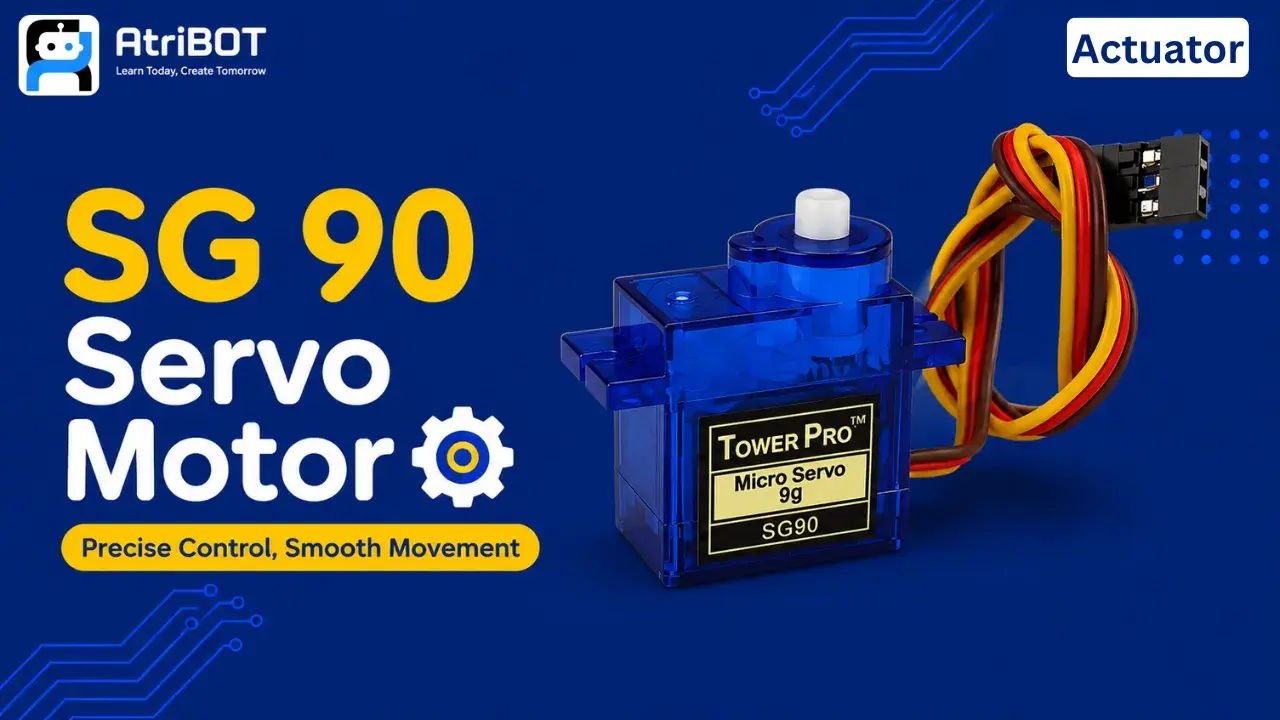
SG90 Servo Motor

Written by
Atribot team
Last updated
June 10, 2026
Introduction
How does a robotic arm move to an exact position? How can a smart gate open to a specific angle and stop precisely where it should? Unlike ordinary DC motors that rotate continuously, servo motors are designed to move to a specific position with high accuracy.
The SG90 Servo Motor is one of the most popular servo motors used in electronics and Arduino projects. It combines a DC motor, gears, and a control circuit in a compact package, allowing it to rotate to a desired angle based on control signals.
Because of its precise movement, low cost, and easy interfacing, the SG90 servo motor is widely used in robotics, automation systems, remote-controlled vehicles, robotic arms, and educational projects.
In this article, you will learn about the SG90 servo motor's main parts, pin configuration, technical specifications, working principle, advantages, disadvantages, and real-world applications.
Main Parts
Inside a typical SG90 servo motor, you'll find five main components working together to provide precise position control: a DC motor, a gearbox, a servo horn, a potentiometer, and a control unit.
DC Motor: The DC motor is the core component that generates rotational movement inside the servo. It provides the mechanical force required to rotate the output shaft and is connected to the gear system that controls the servo's movement.
Gearbox: The gearbox consists of a series of reduction gears that increase the motor's torque while reducing its speed. This allows the servo to move with greater precision and enough force to drive external mechanisms.
Servo Horn: The servo horn is a plastic arm or wheel attached to the output shaft of the servo motor. It serves as the connection point for external components such as robotic arms, steering systems, gates, or other moving parts.
Potentiometer: The potentiometer acts as a position sensor and is directly connected to the output shaft. As the shaft rotates, the potentiometer changes its resistance value, allowing the servo to continuously monitor its current position.
Control Unit: The control unit is the brain of the servo motor. It receives control signals from a microcontroller, compares the desired position with the actual position reported by the potentiometer, and controls the DC motor until the correct position is reached.
Together, these components form a closed-loop control system that allows the SG90 servo motor to rotate accurately and hold a specific position, making it ideal for robotics, automation, and Arduino projects.
Pinouts
The SG90 servo motor has three wires.
Wire Color | Pin | Description |
|---|---|---|
Brown | GND | Ground |
Red | VCC | Power Supply |
Orange | Signal | PWM Control Signal |
GND Connected to the ground of the circuit.
VCC Provides power to the servo motor.
Signal Receives PWM signals from a microcontroller to control the rotation angle.
Specifications
Parameter | Specification |
|---|---|
Operating Voltage | 4.8V – 6V |
Stall Torque | 1.8 kg-cm |
Operating Speed | 0.1 sec/60° |
Rotation Range | 0° – 180° |
Control Method | PWM |
Weight | 9 g |
Gear Type | Plastic Gears |
Motor Type | DC Motor |
Wire Length | Approximately 25 cm |
Operating Temperature | 0°C to 55°C |
Working Principle
The SG90 servo motor operates using a closed-loop feedback system that allows it to rotate to a specific position and hold that position accurately. Unlike a standard DC motor that rotates continuously, a servo motor moves to a desired angle based on the control signal it receives.
When a PWM (Pulse Width Modulation) signal is applied to the signal pin, the control unit inside the servo interprets the pulse width and determines the target position. The control unit then compares this desired position with the current position of the output shaft.
To determine the shaft's position, the servo uses a built-in potentiometer connected directly to the output shaft. The potentiometer continuously provides feedback to the control unit, allowing it to monitor the exact angle of rotation.
If the current position does not match the desired position, the control unit drives the DC motor through the gearbox until the shaft reaches the required angle. Once the desired position is achieved, the motor stops rotating and maintains that position until a new control signal is received.
This continuous process of receiving a control signal, measuring the current position, comparing both values, and correcting the movement enables the servo motor to provide accurate and reliable position control in robotics, automation systems, and Arduino projects.
Advantages & Disadvantages
Servo motors are widely used because they provide accurate position control and easy operation. However, they also have some limitations.
Advantages
Precise position control
Easy to interface with microcontrollers
Compact and lightweight
Low power consumption
Good torque for its size
Fast response time
Holds position accurately
Affordable and widely available
Disadvantages
Limited rotation range
Plastic gears can wear over time
Lower torque than larger servos
Can draw high current under load
Not suitable for continuous rotation applications
Applications
Servo motors are widely used in applications that require accurate position control and controlled movement. Their ability to rotate to specific angles makes them ideal for robotics, automation, and motion control systems.
Robotic Arms: Servo motors are commonly used in robotic arms to control the movement of joints and provide precise positioning for pick-and-place operations.
Obstacle Avoidance Robots: In mobile robots, servo motors are used to rotate ultrasonic sensors or cameras, allowing the robot to scan its surroundings and detect obstacles.
Automatic Gates: Servo motors can be used to open and close gates, barriers, and doors at controlled angles with smooth operation.
Smart Dustbins: In automatic dustbin projects, servo motors control the lid movement by opening and closing it when an object is detected.
RC Cars and Aircraft: Servo motors are widely used in remote-controlled vehicles to control steering mechanisms, rudders, elevators, and other moving parts.
Camera Pan-Tilt Systems: Servo motors allow cameras to rotate horizontally and vertically, making them useful in surveillance and tracking applications.
Industrial Automation: Many automated machines use servo motors for accurate positioning and controlled mechanical movement.
CNC and Robotics Projects: Servo motors help control precise movements in robotic systems and computer-controlled machines.
Solar Tracking Systems: Servo motors adjust the position of solar panels throughout the day to maximize sunlight exposure.
Educational Arduino Projects: Servo motors are among the most popular actuators used in Arduino projects, helping beginners learn about motion control and automation.
The SG90 Servo Motor is one of the most versatile actuators available, offering accurate position control, simple interfacing, and reliable performance for a wide range of electronics and robotics applications.